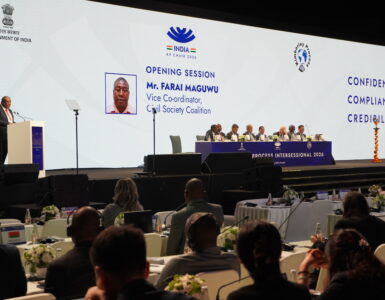

Opening remarks by the Kimberley Process Civil Society Coalition in Dubai on November 17th.
As we open the Kimberley Process plenary today, this is the moment for the Civil Society Coalition to recall the KP’s core objective: to break the link between diamonds and conflict, wherever and however it occurs.
The ultimate purpose of this certification scheme is to protect communities from diamond-fuelled violence and conflict – not to give consumers peace of mind, safeguard corporate interests, or shield governments from legitimate concerns that they themselves may be the link between diamonds and conflict today. Whether it is Russia or Israel using diamond revenues to finance illegitimate wars and bloodshed, police violently targeting artisanal miners in some KP participant countries, or a mercenary group in the Central African Republic seizing the diamond trade by force, all of this goes to the heart of this body’s mandate.
Peace is not just about the absence of violence, it is also about safeguarding livelihoods and overall well-being. Last month, the Civil Society Coalition visited diamond-mining communities around the Letseng Diamonds mine in Lesotho to hear their concerns and engage with the company, which we thank for the open discussions, and site visit. Community members around Letseng mine told us they live in constant fear that the mine’s tailing dam will burst, and that their drinking water is polluted. These concerns must be taken into account very seriously.
Closing your eyes to these realities is undermining the very foundations of this scheme and eroding public trust in the KP and the diamond sector at large.
Watch our documentary “Beyond Shining Illusions” and the KP CSC’ critical assessment of the Kimberley Process.
The pursuit of “best practices” must start with an honest response to the KP’s failures
The KP Chair baptized the year 2025 as the year of “Best Practice” for the Kimberley Process. While promoting and encouraging Best Practices, we should also honestly acknowledge and address KP shortcomings. We are now into the last year of another KP reform cycle, yet the challenges remain depressingly familiar.
Conflict diamonds are diamonds that fund violence – nothing more, nothing less
So far, the proposals for an updated definition of conflict diamonds still fail, in our view, to address today’s ongoing violence and conflicts fueled by the diamond trade. Time and again, discussions get stuck in language that seeks to avoid rather than achieve meaningful change – language that prioritizes government interests over the protection of communities. This is both sad and shameful.
The definition we need is simple; let me spell it out clearly: conflict diamonds are diamonds used to finance widespread or systematic violence. Nothing more, nothing less. All the rest – all the complex wording being proposed – has nothing to do with promoting peace and development, but is only about protecting narrow interests, entrenching greed, and ignoring legitimate grievances. We therefore strongly call on participants not to settle for cosmetic changes that only create the illusion of progress, while doing nothing to prevent diamonds from causing further harm and desperation.
Limits of the quasi-tripartite model
The KP’s so-called tripartite structure – bringing together governments, industry, and civil society – is unequal as only governments have decision-making power but civil society will not bow to intimidation. Some of our members have faced unacceptable acts of slander, intimidation and victimization from some KP participants and even the KP Chair in his closing remarks of the Intersessional in May 2025. The Civil Society Coalition was shocked by such utterances, characterization and victimization faced by our coalition member from Lesotho.
Meaningful consultation between states, companies, communities and local civil society is essential to address existing challenges in mining areas. The Civil Society Coalition will continue to advocate for the protection of affected communities and their fair share of the benefits from the natural resources on their land.
Transparent reporting is key to progressive and collective improvement
Within the KP, strict confidentiality rules create a persistent lack of transparency, which further undermines accountability. Maximum transparency is required and recommended. We commend efforts to improve the visualisation of KP statistics on the KP website. This is a step in the right direction but the KP still has a long way to go.
The KP lifted its sanctions on the Central Africa Republic but the work to break the link between diamonds and violence is unfinished
In November 2024, the embargo on Central African diamonds was lifted under conditions of enhanced vigilance. The Civil Society Coalition is eager to hear from Central African Republic’s (CAR) authorities on the measures taken so far to ensure that the resumption of diamond exports genuinely promotes development, security and community well-being, rather than fuelling fraud, smuggling and renewed conflict.
The Coalition is concerned, however, about the limited flow of information from CAR authorities in this year of enhanced vigilance. CAR has missed several opportunities to report on progress and answer KP members’ questions, including through repeated absences from successive Working Group on Monitoring (WGM) teleconferences. We continue to urge the CAR authorities and the KP not to treat the lifting of the embargo as an end in itself or as a victory, but rather as an opportunity to build a robust roadmap to eradicate fraud and smuggling and to improve traceability through rigorous internal controls.
As long as the Central African mining sector is held in the grip of predatory networks that feed off the very violence they unleash, the KP’s work in CAR remains unfinished.
Why KP is not the answer to today’s mineral governance challenges
It is interesting that the International Conference on the Great Lakes Region (ICGLR) and others approached the KP to learn from it.
In light of the KP’s many shortcomings, we are however concerned by efforts to promote it as a model for the “responsible” governance of other minerals. When we see, for instance, how gold routed through major trading hubs is fuelling violence from the Democratic Republic of Congo to Sudan, it is clear that what is needed is a system grounded in transparency, traceability and accountability.
Exporting the current KP model to such complex challenges would do the opposite: it would offer a façade of responsibility while widening the space for laundering, given its opaque, confidentiality-based proceedings, entrenched conflicts of interest, substandard peer review, and the many loopholes that have remained largely unaddressed for the past twenty years.
Striving for “best practices” or to be a model also means being ready to learn from other schemes. The KP therefore must also be open to learning from other similar mechanisms like the Extractive Industries Transparency Initiative (EITI).
Stronger standards are needed to safeguard communities and to preserve the value natural diamonds provide
There are benefits for expanding the conflict diamond definition for African States under prevailing circumstances when the market for natural diamonds is in distress.
Protection of natural diamond revenues and national economies should be our common concern. The rapidly rising market of synthetic diamonds and their advertising, branding and positioning as ethically and environmentally clean compared to natural diamonds poses a huge risk to natural rough diamonds. Synthetics are riding on being free from the risk of violence or human rights violations.
The new generation of consumers are hugely sensitive to such ethical, environmental and human rights issues or violence. As diamonds are luxury products, they will not hesitate to replace them with other products when they see them as harmful to communities. The risk is that the future of natural diamonds will be damaged irreparably if the KP does not address these issues.
The World Diamond Council (WDC) has already acknowledged the need to support a change in definition of conflict diamonds for sustainability but those hindering any progress in our opinion are the KP participants. The Kimberley Process’ increasing preoccupation with procedural concerns, technicalities and geopolitics alienates it from the realities it is supposed to address. With the reticence to reform that we are currently observing, the KP may continue to falsely certify diamonds affected by widespread or systematic violence as conflict free.
Jaff Bamenjo
KP CSC Coordinator
For more information: info@kpcivilsociety.org