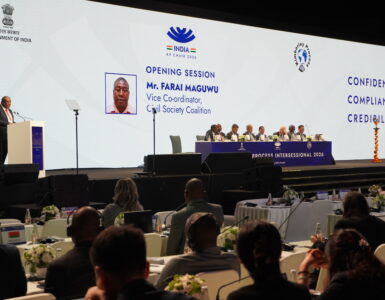

From January 26 to February 1, 2026, the Kimberley Process Civil Society Coalition (KP CSC) held its annual planning meeting in Freetown, Sierra Leone.
Discussions took place against a global backdrop marked by a deep crisis in the diamond industry, the failure of the latest reform cycle of the Kimberley Process (KP), and the growing restriction of civic space in many countries, particularly in Africa. In light of these realities, coalition members jointly strengthened their efforts to defend the human and environmental rights of communities affected by diamond mining.
An active coalition despite the Kimberley Process deadlock.
Participants began by taking stock and evaluating the activities carried out in 2025, highlighting both the progress made and the persistent challenges. One fact remains: communities affected by diamond mining, both artisanal and industrial, are still too often victims of human rights abuses and environmental degradation, as demonstrated by the documentary “Beyond Shining Illusions”, produced by the Coalition in 2025. The documentary’s findings were examined and discussed by a wide range of stakeholders from government, the diamond industry, and civil society.
Despite the urgency, the Kimberley Process has completed a new reform cycle without significant progress in the fight against diamonds tainted by violence. As attention shifts to minerals required for the energy and digital transitions, the diamond sector and the people who depend on it must not fall through the cracks.
The sharing of experiences by members reaffirmed the central role of civil society and its networking in mobilizing for more responsible and equitable mining.
Natural diamonds under threat and lost benefits for affected communities
To develop an effective action strategy, meeting participants discussed the global context. The drop in natural diamond prices and the surge in the market share of synthetic diamonds have direct consequences for African diamond-producing countries, tax revenues, and mining communities. Botswana, for example, where diamond sales accounted for around 30% of GDP, is bearing the brunt of the crisis. It is therefore essential that pressure on tax revenues does not compromise compliance with social and environmental standards.
Furthermore, thousands of artisanal miners depend on income from diamonds. It is striking that the average price per carat of a diamond can vary dramatically between countries such as Angola and the DRC. It is therefore important to reaffirm the economic and social value that natural diamonds can provide.
A renewed strategic framework: Learning from diamond governance as the rush for other minerals gains momentum
In its new strategic plan (2026–2028), the Coalition intends to draw on its two decades of experience as a pillar of civil society within the Kimberley Process to advance more responsible global governance of diamonds and minerals in general.
Faced with the impasse in the Kimberley Process, the Coalition will continue to highlight the limitations of the current definition of conflict diamonds so that it no longer misleads consumers. The KP CSC wishes to work with States willing to improve conditions in the diamond supply chain in order to materialize the social value of natural diamonds.
At the national level, each member reaffirms its commitment to supporting communities affected by mining and promoting positive benefits. This includes promoting the formalization of artisanal mining for the benefit of communities and advocating for best practices in mitigating the impacts of mining, implementing corporate social responsibility measures, and adopting local content policies.
The current rush for critical minerals and gold once again risks causing further negative impacts on communities affected by mineral extraction. The coalition calls on States to learn from the failures of the Kimberley Process to prevent the extraction of (critical) minerals from exacerbating violations of human and environmental rights. Similarly, the Coalition calls on the KP to draw lessons from other responsible sourcing initiatives in order to reform effectively. Drawing on its members’ expertise in diamonds and the KP, as well as in numerous other minerals and initiatives, the Coalition positions itself as a hub for knowledge and exchange on mining. Its goal: to break down silos between ongoing dialogues (on diamonds, gold, critical minerals) in order to advance mining governance in a holistic and structural manner.
This new plan reflects a clear commitment to strengthening collective and proactive action, where civil society plays a central role and acts as a bridge between the various stakeholders among affected communities, the private sector, and institutional actors.
Internal governance and regional leadership
According to its governance principles, the Coalition also organized a leadership transition during its meeting in Freetown. Jaff Bamenjo (RELUFA, Cameroon), who actively served as Coordinator of the KP CSC during his two-year term, handed over the reins to Abu Brima, executive director of the NMJD (Sierra Leone) and a staunch advocate for community rights since the very inception of the Kimberley Process. Farai Maguwu (CNRG, Zimbabwe) was elected Vice-Coordinator.

This transition was accompanied by the election of new Regional Leads responsible for coordinating regional activities and representing them on the Coalition’s steering committee.
- West Africa: Mohamadou Lamarana Diallo (Actions Mines Guinée)
- Southern Africa: Lemeke Koo (MCDF, Lesotho)
- Central Africa: Paul-Crescent Beninga (CCRAG, Central African Republic)
The annual planning meeting held in Freetown in 2026 marked a new milestone in the fight for responsible, equitable, and community-centered mining governance. With an ambitious strategic plan that goes beyond diamonds, the Kimberley Process Civil Society Coalition is positioning itself more than ever as a driving force for change in the face of injustices in the extractive sector.