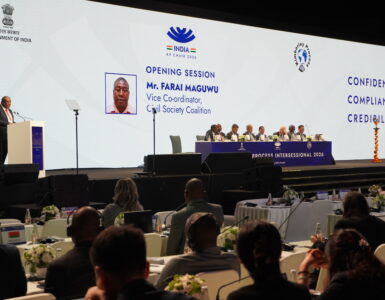

Civil Society closing remarks at the Kimberley Process Intersessional meeting in Mumbai – 14th May
We have witnessed with deep concern a growing tendency within this forum to reposition the Kimberley Process (KP) primarily as a branding tool for natural diamonds. While we understand the economic pressures facing the industry, and while we would welcome the positive narratives promoted here to fully reflect realities on the ground, civil society must emphasise that diamond governance and mining practices in many contexts still fall short of the standards this scheme was created to uphold.
The KP was not established as a trade promotion framework. Its core mandate remains the prevention of diamonds funding insecurity and conflict, and its legitimacy depends on its ability to address these challenges credibly and transparently.
It is therefore striking that the priorities increasingly expressed within this forum contrast sharply with how many of the same governments present the KP internationally. Allow me to quote an excerpt from the UN General Assembly resolution adopted in April 2025:
“The General Assembly, encourages further strengthening of the Kimberley Process to enhance its effectiveness in addressing challenges posed to the diamond industry and related communities, including from instability and conflict, and to ensure that the Kimberley Process remains relevant for the future and continues to contribute to international peace and security and the achievement of the 2030 Agenda and the Sustainable Development Goals, and looks forward to further exploring and advancing the ways in which the Kimberley Process contributes to peacebuilding and sustaining peace.”
This language recognises that the future relevance of the KP will not be secured through marketing, but through meaningful efforts to strengthen its effectiveness, credibility and contribution to peace, security and development.
Rather than transforming the KP into a marketing tool, Participants and industry should focus on improving realities on the ground. The decline in natural diamond prices affects not only companies and producing-country governments, but also communities dependent on diamond mining. Artisanal miners face declining deposits and falling prices, workers in large-scale mines are losing jobs, and funding for social and environmental programmes is increasingly under pressure.
The Kimberley Process cannot market credibility it has not earned. Its long-term relevance depends on fulfilling its mandate effectively and transparently.
For civil society, this requires tangible progress in the following areas:
- Preventing diamonds from financing conflict
Preventing diamonds from financing conflict lies at the heart of the KP mandate. Yet in 2025, the KP once again failed to reform its definition of conflict diamonds. Violence, human rights abuses — regardless of the perpetrator — and environmental harm linked to diamonds will not disappear through marketing campaigns. The KP cannot afford to wait until the 2028 reform cycle to finally begin addressing these realities.
- Promoting responsible sourcing
Responsible sourcing must prioritise the rights and well-being of communities affected by diamond mining, not merely consumer reassurance.
The reform challenge goes far beyond expanding the conflict diamond definition. The KP needs to move beyond a binary, box-ticking approach to compliance and peer review. It should develop stronger tools to identify risks, address governance failures and transparently communicate both progress and persistent shortcomings. Civil society remains concerned by the lack of ambition in this regard.
Opacity in the diamond trade continues to undermine responsible sourcing. Greater transparency on diamond origin and chain of custody is essential for meaningful due diligence and accountability.
Traceability will require technological solutions, but technology alone is not enough. The key question is what traceability is meant to achieve: understanding impacts, identifying risks and preventing harm. Solutions must therefore be inclusive, context-sensitive and co-designed with all stakeholders, particularly to avoid excluding the artisanal and small-scale mining sector.
The structure of the KP can be an asset if leveraged effectively. While traceability systems must reflect local realities, Participants and Observers can collaborate on interoperability and shared approaches so that traceability becomes a collective investment in progressive improvement rather than another source of exclusion.

- Increasing transparency in trade data
The exchange of trade statistics among Participants is valuable, but opening the KP statistics database to public scrutiny would significantly strengthen efforts to detect illicit financial flows, transfer mispricing, trade-based money laundering, smuggling and fraud. Greater transparency would improve accountability and help restore confidence in the scheme.
- Advancing diamond governance through open dialogue
The Kimberley Process frequently highlights its role as a forum for dialogue. Genuine dialogue, however, requires openness about failures, willingness to address uncomfortable realities and readiness to work collectively toward solutions.
This dialogue should also welcome external expertise and broader developments in mineral governance. Producing countries are actively reforming legal frameworks, strengthening oversight and seeking greater local beneficiation. The KP should engage with and learn from these dynamics rather than operate in isolation.
Civil society welcomes the frank discussions within the Working Group on Artisanal and Alluvial Production, including renewed efforts toward regional dialogue in Central Africa. These are precisely the kinds of discussions the KP should encourage and build upon.
We also welcome the Working Group on Monitoring’s more open-ended assessment of annual reports, which creates greater space to identify and follow up on implementation gaps.
- Supporting a credible and effective KP Secretariat
We commend those Participants and Observers that continue to support the KP Secretariat financially. We are concerned that some members wish to shape the future of the KP while failing to contribute to sustaining one of the few meaningful institutional advances of the last reform cycle.
The Secretariat remains essential to the professionalisation and effective functioning of the KP. Yet this week’s discussions have shown how fragile this progress remains. A professional and adequately resourced Secretariat is indispensable if the KP is serious about reform, implementation and credibility. The Secretariat must therefore be given the means necessary to fulfil its mandate.
As I conclude, I return to the message from our opening remarks: confidence requires honesty.
If the KP seeks credibility, it must communicate honestly about what it is, what it can realistically achieve and where it continues to fail. It cannot claim to ensure a conflict-free diamond trade while ignoring diamond-related violence or conflicts financed through diamonds.
For this reason, we urge Participants to add a fourth “C” to this year’s priorities of “Confidence, Compliance and Credibility”: Commitment. Credibility starts with commitment to affected communities and to meaningful reform.


Farai Maguwu,
Vice Coordinator of the Kimberley Process Civil Society Coalition
More information: info@kpcivilsociety.org